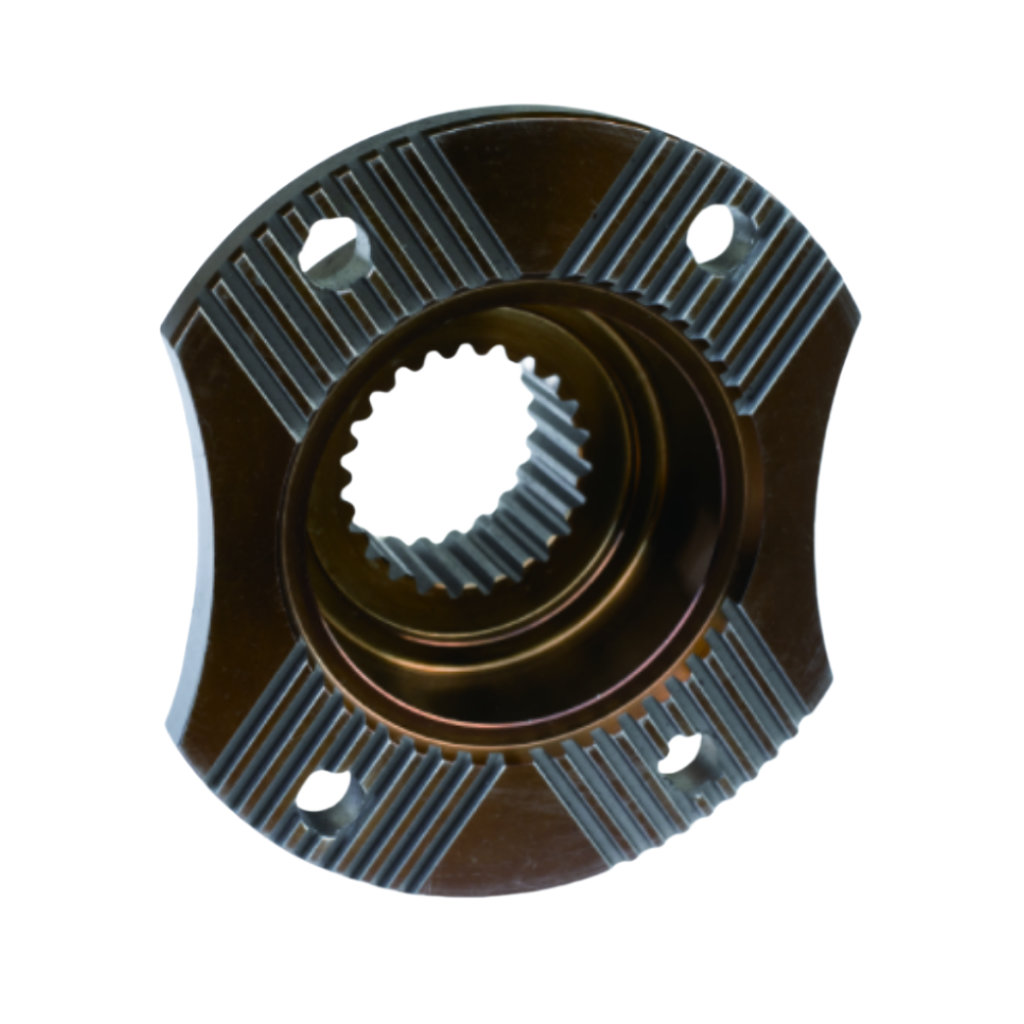
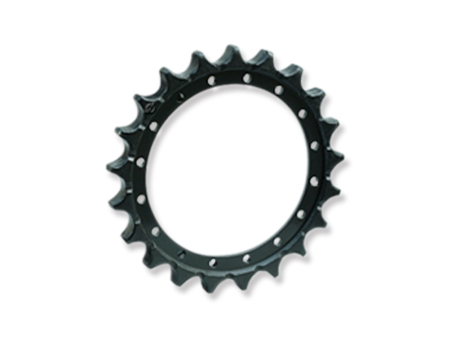
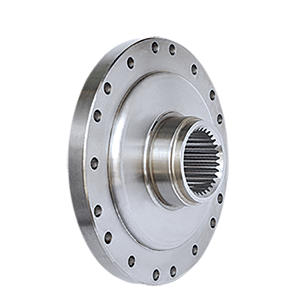
In quarrying, open-pit mining, and heavy foundation excavation, the undercarriage routinely accounts for more than half of a machine's total maintenance spend. Among all undercarriage components, the drive sprocket (also called drive wheel) is the first to show wear — and if allowed to run past its service limit, a hooked tooth profile forces the track chain to climb, dramatically accelerating bushing-pitch elongation and shortening roller life. The Sprocket for SDLGE665F — Forged Alloy Steel Excavator Sprocket 50-55 HRC Surface Hardness CNC Machined Tooth Profile Double Sealed Bearing Zinc Nickel Plating Corrosion Protection OEM Compatible Track Chain Engagement (Manufactured by Liancheng Machinery Co., Ltd.) is specified to break that failure cascade. It begins as a closed-die forged alloy-steel billet — grain flow aligned to the tooth root — is quenched and tempered to a working-surface hardness of 50–55 HRC, then CNC-machined to the exact SDLGE665F pitch-circle and tooth form so that chain bushings seat uniformly across all engaged teeth. A zinc-nickel plus passivate coating resists red-rust in wet, saline, or chemically aggressive pit environments. But how does through-hardened forged construction compare to flame-hardened cast sprockets in real wear life, what tooth-condition thresholds should trigger replacement beforechain damage, and why does CNC tooth accuracy matter for pitch-preservation? Here is the full breakdown for fleet managers, undercarriage technicians, and equipment dealers.
Forged Alloy Steel + Through-Hardening vs. Flame-Hardened Cast Sprockets
A Sprocket for SDLGE665F — Forged Alloy Steel Excavator Sprocket 50-55 HRC Surface Hardness CNC Machined Tooth Profile Double Sealed Bearing Zinc Nickel Plating Corrosion Protection OEM Compatible Track Chain Engagement (Manufactured by Liancheng Machinery Co., Ltd.) derives its advantage from three metallurgical and geometric factors:
Closed-Die Forged Grain Alignment: The forging process elongates the steel's grain boundaries to follow the tooth contour and hub-web radii. This aligned microstructure resists tooth-root fatigue cracking under shock torque (e.g., bucket striking buried rock) far better than the random equiaxed grains of a sand-cast sprocket.
Through-Hardened 50–55 HRC Working Surface: After rough machining, the blank is quenched and tempered so hardness penetrates the full tooth section — not merely a 0.5–1.0 mm carburized case. As the tooth surface abrades over thousands of hours, freshly exposed material retains similar hardness, avoiding the rapid secondary-wear that occurs once a thin case-hardened layer is breached.
CNC Tooth-Form Accuracy (±0.05–0.10 mm Pitch-Line Tolerance): Computer-controlled profiling ensures each tooth shares load equally with the chain bushing — eliminating "single-tooth overload" that hooks a soft sprocket prematurely and accelerates chain pitch-walk.
Field data from limestone and iron-ore sites show Liancheng forged sprockets retaining serviceable tooth form 2–3× longer than commodity flame-hardened cast equivalents before reaching the 7 % thickness-loss replacement threshold.
Key Specifications (From Liancheng SDLGE665F Sprocket Page)
Product Designation: Sprocket for SDLGE665F
Base Material: High-grade alloy structural steel (forged billet — e.g., 42CrMoA / 40CrNiMoA family; grade confirmed per batch)
Heat Treatment: Quench + Temper → surface hardness 50–55 HRC measured at pitch line; core toughness retained (Charpy V-notch typically 35–60 J)
Tooth Profile: CNC-machined to match SDLGE665F track chain pitch & roller diameter (tooth count per OEM — commonly 21–23 T for this class; verify against machine serial)
Hub / Bearing Interface: Pilot-bored to match SDLGE665F final-drive flange; dual-lip labyrinth-sealed bearing (pre-lubricated taper-roller or ball as specified); bolt-circle & offset OEM-equivalent
Dynamic Balance: Spin-balanced to G 6.3 or better — reduces secondary vibration that can loosen mounting bolts and fatigue final-drive bearings
Corrosion Protection: Zinc-Nickel alloy plating + trivalent chromate + clear/black passivate topcoat; salt-spray resistance typically > 240 h per ASTM B117 (red-rust onset)
Mass (Approx.): 45–60 kg depending on tooth count / hub depth — confirm per inquiry
Compatible Machines: SDLGE665F and same-undercarriage SDLG models; also adaptable to other OEMs sharing identical pitch & bolt pattern (consult Liancheng)
Documentation Supplied: Dimensional inspection report + hardness test cert per batch; material test certificate (EN 10204 3.1) on request
Field Signs a Sprocket Needs Replacement — Before It Ruins the Chain
Inspect sprocket teeth during every 250 h undercarriage PM check:
Hooked Tooth Tip (Visual): Original flat-arc tip wears concave ("hooks"). If a 3 mm feeler slides under the backof the tooth tip when chain is engaged → excessive hook — schedule replacement.
Tooth-Thickness Loss > 5–7 % of Original: Measure with caliper or sprocket-wear gauge at pitch line. > 7 % loss (or chain beginning to ride up > 1/3 tooth height) = immediate replace.
Chain Climb / Slippage on Heavy Reverse or Side-Slope: If track occasionally jumps or climbs sprocket under load andteeth appear pointed/hooked → sprocket is primary suspect even if chain pitch-elongation is borderline.
Uneven Wear (One Side Worse): Signals misaligned final-drive flange or bent axle — correct alignment beforeinstalling new sprocket or one-side premature wear recurs.
Bearing Play / Seal Weep: Perceptible axial/radial play or contaminated grease in hub bearing → rebuild or replace complete assembly; ignoring it overstresses new teeth.
Best Practice: Always replace sprockets in pairs(LH + RH). When chain pitch elongation exceeds 2–3 %, replace chain & rollers simultaneously — a new sprocket on a badly stretched chain accelerates hook formation and abnormal bushing wear.
Correct Installation & Commissioning
Clean Final-Drive Pilot & Bolt Holes: Remove old gasket, paint overspray, and corrosion — ensures drive wheel seats flush and runs true.
Apply Medium-Strength Threadlocker (e.g., Loctite 243) to Mounting Bolts: Prevents vibrational loosening; do NOT use high-strength permanent locker unless OEM specifies.
Torque in Star Pattern to OEM Value: Typically 180–220 N·m for M20–M24 class 10.9 bolts on this machine class — confirm exact spec per service manual. Re-torque after first 10 operating hours.
Verify / Grease Hub Bearing: Sealed-for-life bearings need no initial grease; greaseable types — pump NLGI #2 EP lithium or polyurea until fresh appears at relief, then stop (over-greasing blows seals).
Run-In Re-Check: After 50 h, re-inspect bolt torque and listen for unusual whine — mild meshing sound while new teeth bed into slightly worn (but acceptable) chain is normal and diminishes.
Sourcing Checklist for Fleet Managers & Distributors
When requesting a quote for the Sprocket for SDLGE665F — Forged Alloy Steel Excavator Sprocket 50-55 HRC Surface Hardness CNC Machined Tooth Profile Double Sealed Bearing Zinc Nickel Plating Corrosion Protection OEM Compatible Track Chain Engagement (Manufactured by Liancheng Machinery Co., Ltd.):
✅ Provide machine serial number / year → confirms tooth count, bolt pattern offset, mid-production changes.
✅ Specify quantity (pair per machine; fleet qty for stock).
✅ Request MTC (material test cert) + hardness & dimensional inspection report.
✅ Ask about matching undercarriage kit (track chain + top/bottom rollers + idler + sprocket) — often better priced than piecemeal.
✅ Confirm warranty terms (typically 12 months / 2000 h against mfg. defect) and lead time (stock or made-to-order).
Conclusion: The First Line of Defense for Your Undercarriage Budget
The Sprocket for SDLGE665F — Forged Alloy Steel Excavator Sprocket 50-55 HRC Surface Hardness CNC Machined Tooth Profile Double Sealed Bearing Zinc Nickel Plating Corrosion Protection OEM Compatible Track Chain Engagement (Manufactured by Liancheng Machinery Co., Ltd.) is not a commodity cast replacement — it is a metallurgically upgraded, dynamically balanced, sealed-and-plated component that directly protects your track-chain investment. By resisting tooth-profile loss 2–3× longer than flame-hardened cast sprockets and eliminating vibration-induced bolt loosening, it postpones the point at which the entire undercarriage must be renewed. For fleet managers and undercarriage specialists targeting lowest total cost per hour, specifying a forged alloy-steel sprocket with documented hardness, balance, and corrosion-protection data — like this Liancheng unit — is the correct preventive-maintenance decision.