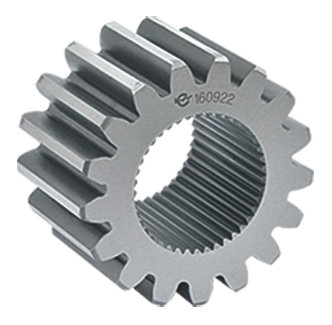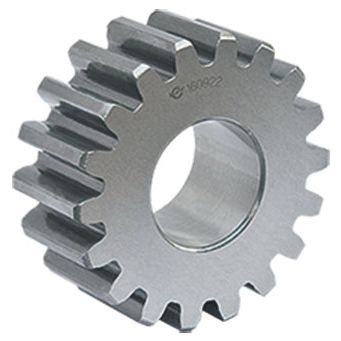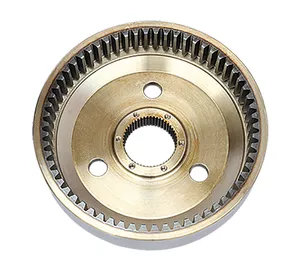
When upgrading or replacing gears inside a loader’s final drive or planetary gearbox, many equipment owners ask the same question: “Does a gear with more teeth perform better?” At first glance, it seems obvious—more teeth, more strength, right? But the truth is a bit more nuanced. Tooth count does influence performance, but “more” doesn’t always mean “better.” It depends entirely on how the machine is designed to work.
To help you make the right decision, let’s explore what tooth count really means, how it affects your loader’s operation, and when a higher number is beneficial.
Gear tooth count directly shapes how power moves through the drivetrain. It influences:
Gear ratio
Torque transmission
Rotational speed
Load distribution
Wear and fatigue patterns
Compatibility with mating gears
In other words, tooth count is not just a number—it’s a key parameter that determines how your loader performs under real working conditions.
A gear with more teeth tends to distribute force more evenly.
This helps:
Improve impact resistance
Prevent chipping and tooth breakage
Reduce vibration
Extend the lifespan of the planetary system
This is why models like Liugong 50 often use a 62-tooth gear—the machine is designed for heavy digging, material loading, and long shifts.
More teeth mean smoother meshing between the sun gear, planetary gears, and internal ring gear. If your loader runs in environments where noise control matters—like construction sites near residential areas—a higher tooth count can help maintain stable operation.
Some loaders rely on extremely strong torque, especially when working with:
Dense material
Wet soil
Gravel and crushed stone
Mining or quarry loading
Steep slope operations
Higher tooth count gears help the machinery push through resistance with less stress on each tooth.
Although more teeth sound appealing, there are situations where a lower tooth count performs better.
A gear with fewer teeth rotates faster.
This benefits:
High-speed loading cycles
Short-distance transportation
Rapid bucket movement
Light-duty operations
If your loader prioritizes speed over extreme torque, a smaller tooth count may be the correct choice.
You cannot simply increase tooth count without affecting the entire drivetrain.
Gear systems must maintain:
Sun gear balance
Ring gear compatibility
Planetary spacing
Shaft alignment
Load distribution geometry
Using a higher tooth count gear in the wrong machine can lead to:
Abnormal noise
Overheating
Accelerated wear
Gear misalignment
Sudden failure
This is why loaders like SDLG 50 or XCMG 50 have standardized 51-tooth or 67:50 spline combinations. These numbers are carefully engineered, not optional.
Even the best tooth count won’t help if the gear isn’t heat-treated properly.
A high-quality loader gear should have:
A hardened surface for wear resistance
A tough inner core to absorb impact
Balanced hardness from quenching and tempering (QT)
Precise tolerances from CNC machining
Many professional buyers choose large China manufacturers and suppliers because they combine forging, machining, and heat treatment in one facility—ensuring stable quality batch after batch.
And honestly, once you’ve used a well-treated gear, you notice the difference immediately. The machine runs smoother, the sound becomes cleaner, and it just feels better to operate.
Here’s the simple rule:
You need more torque
You work in heavy-load conditions
You want smoother and quieter gear engagement
Your loader is designed for it (e.g., Liugong 50 series)
You need faster cycle speeds
You’re doing light-duty work
Your machine’s original configuration requires it
You want optimal gear ratio balance
Always match the tooth count to your loader model and working conditions. If unsure, checking your old gear—or asking a professional supplier—is the safest move.